Looking for boy names starting with "Bu"? Here's a list of 8 options that blend history, nature, and warm, approachable vibes:
- Bubba: A casual, affectionate name meaning "brother" or "boy", rooted in American slang and German origins.
- Buell: Derived from German origins, it translates to "hill dweller" and carries a vintage charm.
- Buck: A rugged, nature-inspired name meaning "male deer", tied to strength and independence.
- Bud: A nostalgic choice symbolizing growth and companionship, often used as a nickname.
- Buford: Meaning "ford near the aviary", this name combines historical depth with a sense of permanence.
- Bunyan: Linked to literary and folklore traditions, it offers a layered backstory tied to John Bunyan and Paul Bunyan.
- Burke: A surname-turned-first-name meaning "fortified settlement", with Anglo-Norman roots and a modern edge.
- Buckley: Combining "deer meadow" with Irish and English heritage, this name feels grounded yet distinctive.
Each name offers something unique, whether you're drawn to nature, history, or a friendly and approachable vibe. Choose the one that resonates most with your vision.
Quick Comparison Table
| Name | Origin | Meaning | Key Traits |
|---|---|---|---|
| Bubba | German/English | Brother; boy | Warm, casual, affectionate |
| Buell | German | Hill dweller | Vintage, nature connection |
| Buck | Old English | Male deer | Rugged, strong, outdoorsy |
| Bud | English | Growth; companion | Nostalgic, botanical, friendly |
| Buford | Old English | Ford near aviary | Historical, strong, grounded |
| Bunyan | English | Linked to folklore | Literary, folkloric, layered |
| Burke | Old French | Fortified settlement | Surname-style, modern |
| Buckley | English/Irish | Deer meadow | Nature-inspired, serene |
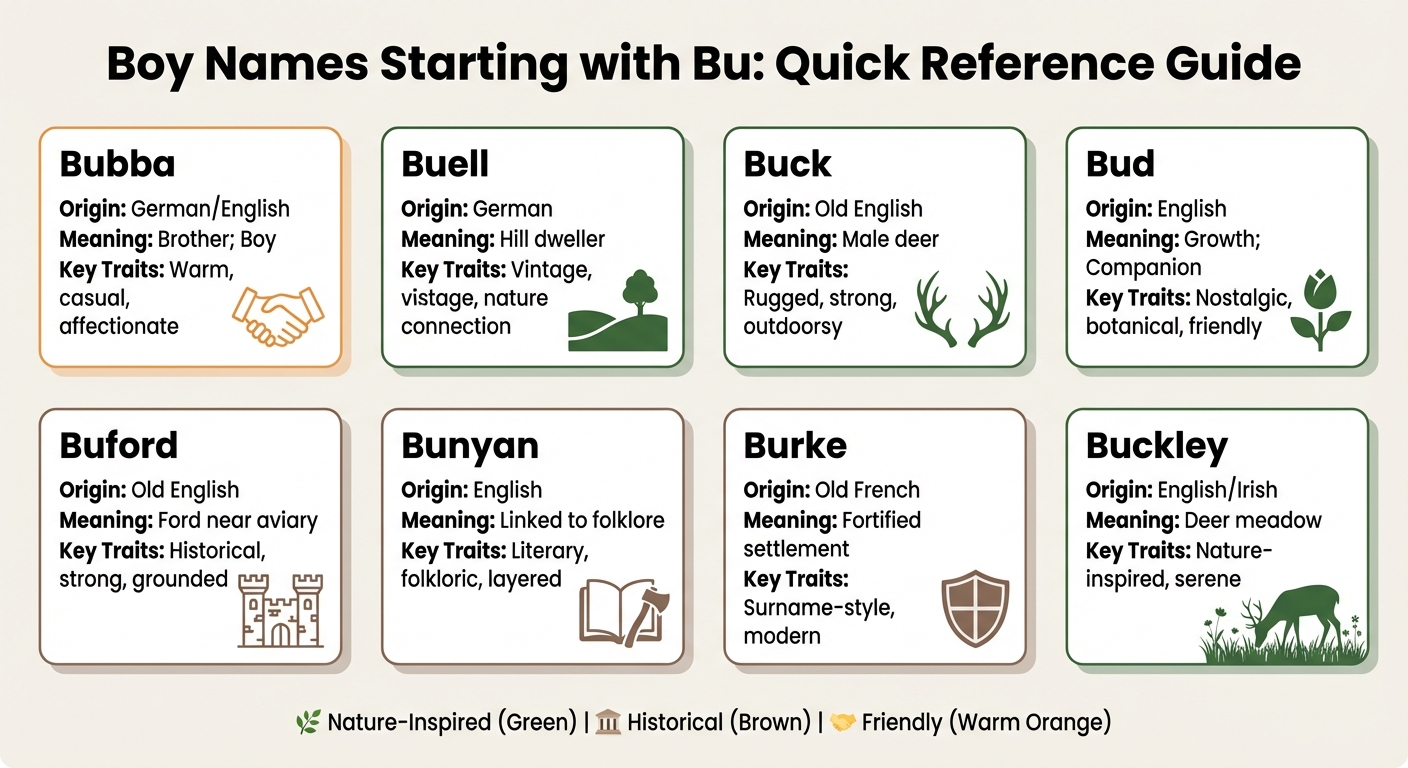
Boy Names Starting with Bu: Quick Reference Guide with Origins and Meanings
1. Bubba
Origin
The name Bubba traces its roots to American slang, where it was commonly used to mean "brother". Its origins, however, go deeper, connecting to the German word Bube, which translates to "boy". Interestingly, linguists have also pointed out similarities with African terms like Krio bohboh and Gullah buhbuh, which carry the same meaning. Over time, Bubba became a staple in the culture of the Southern United States, transitioning from a family nickname to a recognized first name.
Meaning
Bubba is often associated with meanings like "brother", "pal", or "boy". Beyond its casual and affectionate tone, the name held a special place in African American communities in the early 20th century, symbolizing unity and support during difficult social periods.
Cultural or Historical Significance
Bubba’s popularity peaked in 1923, with its usage climbing to nine per million by 1982. The name gained international attention thanks to the character Bubba Blue in the 1994 movie Forrest Gump. This character even inspired the creation of the Bubba Gump Shrimp Company restaurant chain. Over the years, notable individuals like golfer Bubba Watson, NASCAR driver Bubba Wallace, and former NFL player Bubba Smith have further cemented the name in public consciousness.
Modern Appeal
As of 2025, Bubba holds the #1,360 spot in popularity rankings in the United States, according to BabyCenter. Its warm, approachable sound and strong American roots make it a charming, albeit informal, choice for parents today. Up next, we’ll delve into another "Bu" name with a rich history and cultural resonance.
sbb-itb-f13f980
2. Buell
Origin
The name Buell traces its roots back to the German Rhineland, where it evolved from the surname Bewer before making its way across the Atlantic. Some historical records also suggest a possible Welsh variant, Bowell, though its German origins are more widely recognized. Buell transitioned from a surname to a first name, gaining traction during and after the American Civil War. This rise in popularity was partly influenced by Union General Don Carlos Buell (1818–1898).
Meaning
Buell translates to "hill dweller", a name that reflects a connection to nature and the landscape. Variations of the name include Buel, Bueller, Buhl, and Buhler.
Cultural or Historical Significance
Buell reached its peak as a first name in the 1910s, ranking 1,313 at the time. Today, it has become far less common, sitting at rank 9,065. While rare as a given name, it remains a prevalent surname in the United States, ranking within the top 3% at 4,985 out of more than 150,000 surnames.
The name also carries a modern association with the Buell Motorcycle Company, established in 1983 by Erik Buell, a former Harley-Davidson engineer.
Modern Appeal
With its vintage charm and the growing trend of using surnames as first names, Buell offers a distinctive choice for parents seeking something less conventional. Up next, discover another 'Bu' name that brings its own unique history to the table.
3. Buck
Origin
Following names like Bubba and Buell, Buck stands out as a rugged, nature-inspired option with deep traditional roots. The name traces back to Old English, derived from bucc (male deer) or bucca (he-goat). It also has Germanic origins, often appearing as a shortened version of Burckhard. In some cases, it served as a topographic name for individuals living near a beech tree, stemming from buk in Middle English. Initially used as a nickname for men with deer-like agility, Buck eventually evolved into a given name that embodies resilience and individuality.
Meaning
Buck is most commonly associated with "male deer" or "antelope". This connection to the animal world conveys strength, agility, and a sense of independence. Its natural origins give the name an outdoor vibe, making it an appealing choice for parents looking for names tied to nature.
Cultural or Historical Significance
Buck enjoyed popularity in the early 1900s but has since become less common in modern name rankings. It has long been used as a nickname for classic names like Charles, Robert, William, and James, particularly in Southern American traditions. The name’s cultural resonance was further solidified by Jack London’s 1903 novel, The Call of the Wild. In the story, Buck, the courageous canine protagonist, represents the untamed spirit of the wilderness. Beyond literature, Buck has also been a popular nickname in sports, often associated with athletes known for their strength and rugged determination.
Modern Appeal
Buck fits seamlessly into the category of Western-inspired boy names, evoking a "cowboy spirit" that appeals to fans of Americana. Its one-syllable simplicity and vintage charm align with the rising trend of short, nature-based names. As we continue exploring 'Bu' names, the next option offers yet another distinct cultural touch.
4. Bud
After considering rugged names like Buck, Bud stands out as a softer, more nostalgic alternative with a friendly charm.
Origin
Bud has an interesting history rooted in both Anglo-Saxon and Middle English traditions. Originally, it was a medieval nickname often linked to names like Bernard, Bradford, Burton, or Benjamin. Over time, it evolved into a standalone name. Its origins trace back to the Middle English word "budde," which refers to a flower bud or young shoot. Bud gained traction as a first name in the United States, particularly during the mid-20th century.
Meaning
The name Bud carries a dual meaning. As a botanical term, it represents a small, unopened flower or leaf, symbolizing growth, potential, and fresh beginnings. On the other hand, as a shortened form of "Buddy", it conveys warmth, friendship, and a sense of close companionship. These two meanings combine to evoke both personal growth and connection.
Cultural or Historical Significance
Bud reached its peak as a formal name in the early 1900s and became a hallmark of mid-century American culture, especially in the Southern United States. It often appeared in movies and TV shows as the name of approachable, down-to-earth characters. In some Southern regions, formal names like "Budwell" were naturally shortened to Bud. While its use as a formal first name has waned since the late 1800s, Bud remains a beloved nickname and term of endearment.
Modern Appeal
Bud is making a comeback, riding the wave of the "nickname-as-first-name" trend. By January 2026, it saw a staggering 1,000% surge in interest on major naming platforms within a single week and climbed 1,320 spots in popularity rankings in 2025. Its one-syllable simplicity and vintage Americana vibe appeal to parents seeking names with a timeless feel. The botanical connection also resonates with the growing preference for nature-inspired names, making it especially popular for springtime babies. Bud’s blend of rustic charm and historic appeal - what some call a "Rustic Aristocrat" aesthetic - offers a grounded yet distinctive option for modern parents. This mix of nature, nostalgia, and approachable style makes Bud a standout choice in today’s naming landscape.
5. Buford
Buford stands out as a name that blends historical depth with a sense of strength and permanence. For parents looking for a name with a rich legacy, it offers a distinctive, meaningful choice.
Origin
Buford began as a surname tied to a place in Yorkshire and later transitioned into a given name during the early 20th century. It’s thought to be a variation of "Burford", which translates to "ford near the castle". There’s also a hint of French influence, with connections to "Beaufort" (meaning "beautiful fortress") or the anglicized "Buffard". In the United States, Buford gained popularity after the Civil War, when naming children after military leaders became a common practice.
Meaning
The name Buford carries the meaning "ford near the aviary", though it’s also interpreted as "one from the ford near the castle". Both interpretations tie the name to natural landmarks and fortified structures, evoking imagery of stability and rugged charm. The castle reference adds an element of strength and resilience, making the name feel grounded yet enduring.
Cultural or Historical Significance
The historical weight of Buford is amplified by figures like Major General John Buford Jr., whose leadership at Gettysburg left a lasting mark. Additionally, several U.S. locations, such as Buford, Georgia, are named in honor of individuals bearing the name. Buford, Georgia, incorporated in 1872 and named after railway president Algernon Sidney Buford, became known as "The Leather City" in the early 1900s due to its thriving saddle production for Hollywood stars like Roy Rogers and Gene Autry. The name reached its peak popularity between 1920 and 1929, ranking as high as #354. In 1910, it was given to approximately 0.030% of baby boys, placing it at #311 that year.
Modern Appeal
Buford’s popularity declined sharply after the mid-20th century. By 2023, it ranked at a distant #13,216. Unlike other "Old Man" names that have seen a resurgence, Buford remains largely out of favor and hasn’t broken back into the top 1,000 in the 21st century. However, its modern derivative, "Ford", has gained traction, ranking #635 in 2018. For parents seeking a name with historical heft and a vintage vibe, Buford offers a rare and distinctive option, though its dated feel may not appeal to everyone.
6. Bunyan
Bunyan weaves together threads from medieval England's literary and folkloric traditions, religious history, and American tall tales, offering parents a name with a rich and layered backstory.
Origin
The name Bunyan has Norman-French origins, stemming from "Buignon" and rooted in Bedfordshire, England. Over time, it evolved through 34 different spellings, including variations like Buniun, Bonyon, and Binyan. There's also a link to the Welsh patronymic "Ab Enion", which translates to "son of Enion". While Bunyan began as a surname, it has occasionally been used as a masculine first name, though it remains a rare choice on modern baby name charts.
Meaning
Bunyan’s origins are tied to medieval life, either as a nickname or an occupational name. It comes from the Old French word "bugne", meaning a swelling or bump, or from a baker’s term for crafting "bugnons", which were puffed-up fruit tarts. This connection to everyday medieval life gives the name a grounded, historical charm.
Cultural or Historical Significance
The most renowned figure to bear the name is John Bunyan (1628–1688), the English preacher and author of The Pilgrim's Progress. Imprisoned for 12 years for his faith, Bunyan penned this masterpiece, which became one of the most widely published books in the English language. By 1938, 250 years after his death, over 1,300 editions had been printed, and by 1692, an estimated 100,000 copies were circulating in England alone. His work influenced literary giants like C.S. Lewis, Charles Dickens, and John Steinbeck.
In American folklore, Paul Bunyan represents a different kind of legacy. As a legendary lumberjack, he embodies the rugged strength and pioneering spirit of frontier life. Together, these associations give the name Bunyan a fascinating dual identity, blending literary significance with larger-than-life folklore.
Modern Appeal
As of 2026, Bunyan remains a rare choice, absent from the top 1,000 baby names for boys. While it ranks within the top 21% of common surnames, it is seldom used as a first name. For parents who love surname-inspired names with historical roots, Bunyan offers a compelling option. Its rarity ensures your child will have a distinctive name, yet its ties to John Bunyan and Paul Bunyan keep it familiar and easy to recognize. If you're drawn to names with depth and a touch of literary or folkloric charm, Bunyan is a standout choice with enduring appeal.
7. Burke
Burke seamlessly combines a rich Anglo-Norman heritage with a touch of modern charm.
Origin
The name Burke has roots in both British and French traditions, stemming from the Old English term "burh" and the Old French "de Burgh." Originally, it was a habitational name, identifying people from places like Burgh (meaning "castle") in Suffolk or Lincolnshire, England. Its introduction to Ireland dates back to the 12th century, when William de Burgh, a Hiberno-Norman knight, brought the name during the Anglo-Norman invasions. Over time, it was Gaelicized as "de Búrca." The name’s earliest known use traces back to the 9th century, notably associated with King Burhred of West Mercia.
Meaning
Burke carries meanings tied to strength and protection, translating to "fortress", "fortified hill", or "of the borough." In Irish contexts, it can also imply qualities like "strong" or "fierce." Variations of the name include Burk, Burgh, Bourke, Burgo, and De Burgh, each retaining its connection to the name’s original essence.
Cultural or Historical Significance
The name Burke carries a storied history, prominently tied to the influential Anglo-Irish Burke family, including the Earls of Ulster and Clanricard, who played key roles in Irish political history. Beyond its lineage, the name is associated with notable figures such as Edmund Burke, the Irish philosopher and politician widely regarded as the father of modern English conservatism. Another celebrated bearer is Solomon Burke, the legendary soul and R&B singer who earned a place in the Rock and Roll Hall of Fame. These connections give the name a legacy that spans politics, philosophy, and the arts.
Modern Appeal
As of 2024, Burke ranked #3,218 in U.S. births for boys, reflecting a drop of 681 spots from 2023, continuing its decline since it last appeared in the Top 2,000 in 2014. Emily McNamara, Senior Content Writer at The Bump, highlights its appeal:
"Whether you wish to honor baby's ancestry or want a unique last-name-turned-first-name, Burke is a short and sweet choice that will age well".
Burke fits the growing trend of using surnames as first names while maintaining a timeless, classic feel. Curious about other distinctive 'Bu' names? Keep reading to find more inspiration!
8. Buckley
Buckley combines a touch of nature's charm with a rich historical background, offering a name that feels both grounded and timeless.
Origin
Buckley draws from both English and Irish traditions, creating a name with layered roots. On the English side, it stems from words like bucc (meaning buck or male deer) or bucca (he-goat), paired with lēah (woodland or meadow). Meanwhile, its Irish origins trace back to the Gaelic surname Ó Buachalla, which translates to "descendant of Buachaill." The term buachaill originally referred to a "herdsman", "servant", or "cowherd". Historically, Buckley first appeared as a surname in England during the early 14th century, linked to Buckley Hall in Greater Manchester. While it was a common name in England until the 17th century, its use became more prominent in the U.S. by the 20th century.
Meaning
The name Buckley is often translated as "deer meadow". Other interpretations suggest meanings like "from the goat clearing" or "goat's wood". These nature-inspired translations conjure images of serene meadows and pastoral landscapes, while the Irish roots reflect its connection to herding and agricultural life. This duality gives Buckley a unique blend of natural beauty and occupational heritage.
Cultural and Historical Significance
Buckley has been carried by several notable figures, adding to its cultural resonance. American singer-songwriter Jeff Buckley (1966–1997) remains celebrated for his iconic album Grace and his haunting rendition of "Hallelujah". Irish actress and singer Jessie Buckley, born in 1989, has gained recognition for her performances in Wild Rose and Chernobyl, as well as for earning a Laurence Olivier Award. Additionally, the name is associated with prominent individuals like William F. Buckley, an influential American author and conservative commentator, and Canadian actor A. J. Buckley, known for roles in CSI: NY and SEAL Team.
Modern Appeal
As of 2024, Buckley ranked #2025 among U.S. boy names, climbing 99 spots from the previous year. Its growing popularity reflects a broader trend favoring surnames and nature-inspired names. Balancing a rustic charm with historical depth, Buckley offers a distinctive choice that transitions effortlessly from childhood to adulthood.
Name Comparison Table
This table provides a detailed look at each name's origin, meaning, and historical background, showcasing their rich linguistic and cultural roots.
| Name | Origin | Meaning | Historical Background |
|---|---|---|---|
| Bubba | German / English | Boy; Brother | A term of endearment or nickname in America. |
| Buell | German | Hill dweller | Originally a surname, it became a first name, often used to honor Civil War officers. |
| Buck | Old English | Male deer | Derived from the English word for a male deer; its popularity peaked in the early 1900s. |
| Bud | English | Brother; Buddy | Frequently used as a diminutive or nickname; its usage has declined since the late 19th century. |
| Buford | Old English | Ford near the aviary or castle | A variation of Burford, historically used to honor military leaders. |
| Bunyan | English | Uncertain meaning linked to medieval origins | Best known as a surname (e.g., John Bunyan); rarely used as a first name. |
| Burke | Old French | Fortified settlement or village | Derived from "burgeis", meaning a freeman of a borough; related to the name Berkeley. |
| Buckley | Old English | Deer meadow; Goat's wood | Originally a place name, it is also associated with author William F. Buckley. |
The table reflects the varied linguistic origins and historical connections of these names. From nature-inspired Old English names like Buck and Buckley to German-derived names such as Buell, each carries its own story. Some names, like Buell and Buford, became popular during the 19th century, aligning with the tradition of commemorating Civil War commanders. Others, like Bubba and Bud, began as affectionate nicknames before evolving into standalone given names.
This guide offers a quick way to explore the backgrounds of these names, helping you choose one that aligns with your vision for a name steeped in history and individuality.
Conclusion
These eight Bu names offer a variety of styles to suit different tastes. Buck and Buckley bring a rugged, nature-inspired vibe, while Burke has a modern, professional edge. If you're drawn to vintage charm, Buell, Buford, and Bunyan are great options. For a warm and friendly feel, Bud and Bubba are hard to beat.
Each name carries its own unique flair, making it easier to find one that matches your vision. Whether you're leaning toward the sleek, surname-like style of Burke and Buckley, the outdoorsy essence of Buck, or the timeless appeal of Buell, Buford, and Bunyan, these names strike a balance between honoring tradition and embracing current trends.
Once you've narrowed down your favorites, try NameHatch's swipe-based tool to refine your search. Filter by style, origin, and vibe, sync your preferences, and compare your top choices in real time.
Ready to find the perfect Bu name? Start your free trial today with code TRYHATCH and make the naming process a breeze.
FAQs
What are some cultural or historical connections to the name Bunyan?
The name Bunyan brings to mind John Bunyan (1628–1688), an English preacher and author renowned for his Christian allegory The Pilgrim’s Progress. This influential work, penned during his imprisonment for preaching without a license, has left a lasting mark on English literature and religious thought, particularly in early American culture. The name is often linked to themes of perseverance, faith, and the enduring power of storytelling.
John Bunyan's life offers a glimpse into pivotal moments in history, including the Puritan movement and the turbulent period of the English Civil War. His unwavering stand against the Church of England’s authority underscores his dedication to religious freedom. For parents drawn to figures who embody resilience and a steadfast commitment to their beliefs, the name carries a rich and meaningful legacy.
What’s the difference in meaning between the names Buck and Buckley, even though both are nature-inspired?
While both names draw inspiration from nature, Buck specifically refers to a male deer, evoking images of strength and agility. On the other hand, Buckley translates to “deer meadow,” conjuring a peaceful scene of deer grazing in a quiet meadow. Buck, rooted in Old English, is a bold and direct choice, while Buckley, with its English and Irish heritage, carries a gentler, place-inspired appeal as a surname-turned-first name.
What makes the name Burke a strong and modern choice for boys?
The name Burke is a striking, modern choice with a clean, one-syllable sound that's easy to spell and remember. Meaning 'fortress,' it carries a sense of strength and durability, which adds to its charm. Originally a surname, Burke has transitioned seamlessly into a first name, offering a contemporary yet enduring appeal that suits a child and matures effortlessly into adulthood.