Names starting with "Ben" have a rich history and appeal, blending ancient roots with modern relevance. Derived from the Hebrew word ben (meaning "son"), these names have been popular across various cultures and religions for centuries. From timeless classics like Benjamin to less common options like Benaiah, there's a "Ben" name for every preference.
Here are 15 of the best "Ben" names, along with their meanings and highlights:
- Benjamin: "Son of the right hand"; consistently a top choice in the U.S. and globally beloved.
- Ben: Simple and approachable; a stand-alone name or nickname for Benjamin or Benedict.
- Benedict: "Blessed"; carries elegance and historical significance.
- Bennett: A modern take on Benedict; rising in popularity.
- Benson: "Son of Ben"; stylish and polished.
- Benton: "Town in bent grass"; nature-inspired with historical depth.
- Reuben: "Behold, a son"; a biblical choice with a strong legacy.
- Ruben: A simpler, international variant of Reuben.
- Benaiah: "God has built"; a rare biblical name with spiritual meaning.
- Bence: Hungarian for "victorious" or a diminutive of Benedict.
- Benzion: "Son of Zion"; deeply tied to Jewish heritage.
- Bernard: "Brave as a bear"; classic and enduring.
- Thorbem: "Thor's bear"; Norse-inspired strength with a modern twist.
- Torben: A variation of Thorbem; rooted in Viking history.
- Benuel: "Son of God"; a meaningful, uncommon biblical name.
Each name offers unique qualities, from strong biblical ties to global versatility. Whether you're drawn to timeless favorites or rare gems, these "Ben" names provide meaningful options for your little one.
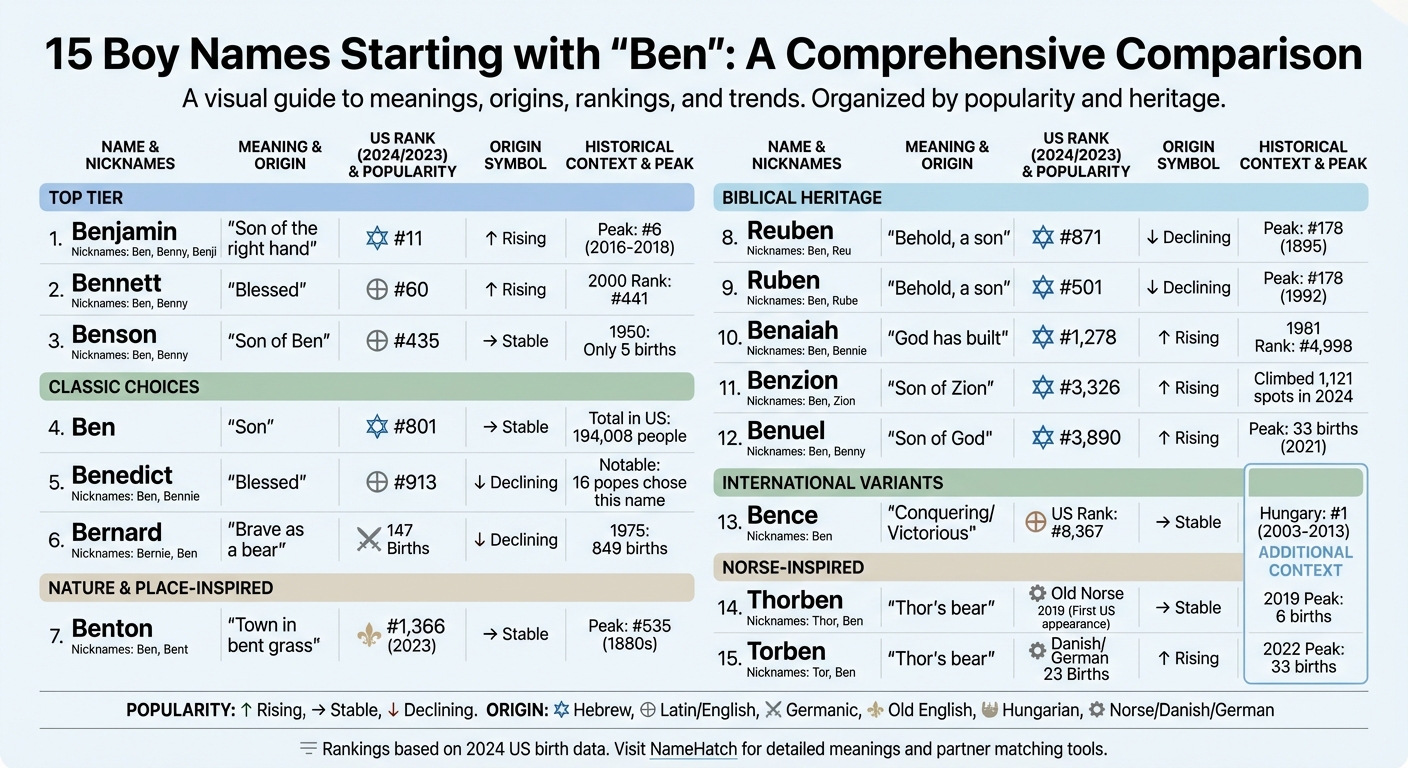
15 Best Boy Names Starting with Ben: Meanings, Origins and Popularity Rankings
1. Benjamin
Meaning and Origin
The name Benjamin comes from the Hebrew Binyāmīn, which translates to "son of the right hand." It can also mean "son of the south" or "son of my days", often referring to a child born later in life. In the Old Testament, Benjamin was the youngest son of Jacob. Initially named Benoni ("son of my sorrow"), his name was changed to Benjamin, giving rise to the common association of the name with the youngest child. This deep historical and biblical significance has helped the name maintain its appeal over time.
Popularity and Cultural Relevance
Benjamin has been a favorite in the United States for decades, consistently ranking among the top 100 boy names since 1968. In 2024, it held the #11 spot, with its highest ranking at #6 between 2016 and 2018. The name’s charm isn’t limited to the U.S.; it’s also widely loved in places like France, Canada, Chile, and South Africa. Its strong biblical roots make it a popular choice across Jewish, Christian, and Muslim communities, adding to its global appeal.
Characteristics and Uses
Benjamin is celebrated for its timelessness and flexibility. It offers an array of nickname options, from the classic "Ben" to the playful "Benji" or "Benny." As Mama Natural describes:
Benjamin is trustworthy and reliably stylish. He's a solid and respected boy's name that does not have a history of overuse like James or John.
Another strength of the name is its adaptability across languages and cultures. Variants like Beniamino (Italian), Binyamin (Arabic/Hebrew), Venyamin (Russian), and Bünyamin (Turkish) ensure it resonates worldwide. There’s even a rare feminine form, Benjamina, showcasing its versatility and enduring charm.
sbb-itb-f13f980
2. Ben
Meaning and Origin
Ben is a Hebrew name that translates to "son." In Dutch traditions, it's often a shortened form of Bernhard. Meanwhile, in Scottish and Irish Gaelic, Ben can mean "a peak or summit." Biblically, it appears as the name of a Levite porter serving at the Jerusalem temple. Eric Partridge once described it as:
"The usual, more manly, diminutive of Benjamin, not of Benedict".
Its simplicity and adaptability have made Ben a favorite across various cultures and traditions.
Popularity and Cultural Relevance
In 2024, Ben ranked 801st in the U.S., dropping five spots from its 2023 position. While this might seem modest, the name has remained in the top 1,000 since 1900, with around 194,008 individuals in the U.S. named Ben, making it the 373rd most common name overall. Globally, Ben enjoys greater acclaim, consistently ranking among the top 10 names in countries like Germany, Northern Ireland, Scotland, and Switzerland. A famous historical figure with the name is English poet and playwright Ben Jonson (1572–1637). More recently, parents have embraced Ben as a stand-alone name, drawn to its concise and approachable charm.
Characteristics and Uses
The essence of Ben lies in its simplicity. It’s youthful, informal, strong, and wholesome - all packed into a single syllable. Its brevity makes it easy to say and remember. Variations like Benny, Benji, Benno, and Benjie add a playful touch, enhancing its friendly vibe. Ben also pairs beautifully with timeless sibling names such as Eleanor, Ruth, James, and Samuel. Its international appeal is evident in linguistic versions like Benito (Italian), Benicio (Spanish), and Benoît (French).
3. Benedict
Meaning and Origin
Benedict stands out as a name with a touch of timeless elegance. It originates from the Late Latin name Benedictus, which translates to "blessed." The name combines bene ("good") and dicere ("to speak"), essentially meaning "well spoken." Its association with Saint Benedict of Nursia, the 6th-century founder of the Benedictine Order, significantly boosted its prominence. However, it wasn't until the 12th century that Benedict gained popularity in England. Within the Catholic Church, the name holds particular importance, with 16 popes - including Joseph Ratzinger, who served as Pope Benedict XVI from 2005 to 2013 - choosing it.
Popularity and Cultural Relevance
As of February 2026, Benedict ranks #913 in U.S. births, showing a modest rise since 2023. While the variant Bennett is far more common - 16 times as popular, to be exact - the traditional form retains its charm, especially among Roman Catholics and those drawn to classic names. The name's modern appeal is also bolstered by public figures like British actor Benedict Cumberbatch and the character Benedict Bridgerton from the hit series Bridgerton. However, Benedict’s historical associations give it a layered, complex legacy.
Characteristics and Uses
Benedict carries an air of sophistication and pairs this with approachable nicknames like Ben and Benny. Parents drawn to Benedict often consider other names with a similarly timeless feel, such as Henry, Oliver, Dominic, or Theodore. Interestingly, there’s been a 5% uptick in interest among parents of rainbow babies. The name also has international variations, including Benoît (French), Benedetto (Italian), Benito (Spanish), and Benedikt (German). Shakespeare even immortalized the variant "Benedick" in Much Ado About Nothing, portraying the character as a witty and confident bachelor.
4. Bennett
Meaning and Origin
Bennett traces its roots back to medieval England as a version of the name Benedict. Coming from the Latin Benedictus - meaning "blessed" - it combines bene ("good") and dicere ("to speak"), hinting at the idea of being "well-spoken." Introduced to Britain by the Normans, Bennett initially gained traction as a surname, with records dating as far back as 1208 in County Durham. Over time, it transitioned into a first name, becoming a stylish and contemporary choice for parents today.
Popularity and Cultural Relevance
In recent decades, Bennett has seen a dramatic rise in popularity. In the U.S., it ranked #441 in 2000 but soared to #60 by 2024, with 5,095 boys given the name - about 0.276% of male births. This reflects a broader trend of using surnames as first names. The name remains widely recognized in the British Isles, including Scotland and Ireland, where it appears as Béinéid. Famous bearers of the name include singer Tony Bennett, director Bennett Miller, and Ben Cohen, the co-founder of Ben & Jerry's. Bennett also has a foothold in pop culture, thanks to characters like Bonnie Bennett from The Vampire Diaries and Shirley Bennett from Community.
Characteristics and Uses
Bennett offers a modern yet timeless feel, often described as strong, polished, and versatile. Its nicknames - Ben, Benny, and Bennie - add a touch of familiarity and charm. It pairs well with other contemporary names, such as Hudson, Everett, Beckett, and Oliver. For siblings, names like Amelia, Charlotte, Graham, and Luke complement its style. International versions of Bennett include Benito (Spanish), Benoît (French), and Benedetto (Italian), giving it a global flair.
5. Benson
Meaning and Origin
Benson is an English name with roots that trace back to its meaning: "son of Ben." It originates from the medieval name Benne, a nickname used for both Benedict (Latin for "blessed") and Benjamin (Hebrew for "son of the right hand"). Beyond its patronymic roots, Benson also has ties to a village in Oxfordshire, first mentioned as "Bensun" in the Domesday Book. Some interpretations even suggest an Old English influence, where "ben" translates to "bean", hinting at a connection to farming - perhaps the son of a bean farmer.
Popularity and Cultural Relevance
Benson has steadily climbed the charts in recent years. By 2024, it reached #435 in the U.S., with 727 boys given the name - a dramatic increase compared to just five instances recorded in 1950. Its rising popularity has been bolstered by modern cultural references. For instance, in September 2023, reality TV stars Becca Kufrin and Thomas Jacobs named their son Benson Lee Kufrin Jacobs. The name also resonates with fans of iconic characters like Benson DuBois from Benson, Freddie Benson from iCarly, and detective Olivia Benson from Law & Order: SVU.
Characteristics and Uses
Benson fits perfectly within the ongoing trend of using surnames as first names. It carries a sense of sophistication while remaining approachable. Parents are drawn to its polished vibe, and it offers familiar nicknames like Ben, Benny, and Benji. Benson pairs seamlessly with other contemporary names like Hudson, Beckett, and Grayson, making it a versatile choice, whether for casual or professional settings. Its blend of tradition and modernity makes it a standout option for families seeking a fresh yet timeless name.
6. Benton
Meaning and Origin
Benton is another "Ben" name with roots in nature. It comes from Old English, combining beonet (bent grass) and tun (town or settlement), meaning "town in bent grass". This connection to the natural world gives Benton a grounded, earthy vibe that appeals to parents drawn to nature-inspired names. Originally, Benton was a place name in England, dating back to the 12th century. Over time, it transitioned from a locational surname to a masculine first name. The name gained traction in the 19th century, partly due to the influence of American politician Thomas Hart Benton. Benton strikes a balance between historical depth and modern charm, much like other "Ben" names.
Popularity and Cultural Relevance
Benton's popularity has fluctuated over the years. It peaked at #535 in the 1880s, disappeared from the top 1,000 for several decades, reappeared in 2011, climbed to #823 in 2016, and landed at #1,366 by 2023. Notable figures with the name include film director Robert Benton, soul singer Brook Benton, and conservationist Benton MacKaye. On-screen, fans might recognize Benton from characters like Dr. Peter Benton on ER and Constable Benton Fraser on Due South.
Characteristics and Uses
Benton offers a fresh alternative to the classic Benjamin while still providing the familiar nickname Ben. It has a polished yet approachable feel that works well in both formal and casual settings. The name’s two-syllable structure gives it a pleasing rhythm, and common nicknames include Ben, Benny, Bent, and even Tony. Parents considering Benton might also explore similar names like Bennett, Brenton, Kenton, or Barrett. With its ties to bent grass, Benton carries a cottagecore aesthetic, making it a great choice for families who value nature and simplicity.
7. Reuben
Meaning and Origin
Reuben is a Hebrew name that translates to "behold, a son." It comes from the Hebrew words ra'a (to see) and ben (son). In the Old Testament, Reuben was the firstborn of Jacob and Leah and the forefather of one of Israel's twelve tribes. The name gained traction as a Christian name in Britain during the Protestant Reformation and has enjoyed steady use since the 18th century. Its biblical and historical significance has kept it consistently in use over the years.
Popularity and Cultural Relevance
Reuben saw its peak popularity in the U.S. during the 1880s, reaching its highest rank of #178 in 1895. Though less common today, it remains in the top 1,000 and ranked #871 in 2024, with 275 boys named Reuben in the U.S. that year. Beyond its biblical roots, the name is also tied to the classic Reuben sandwich - a combination of corned beef, sauerkraut, Swiss cheese, and Russian dressing. Notable namesakes include singer Ruben Studdard, chess grandmaster Reuben Fine, and cartoonist Rube Goldberg.
Characteristics and Uses
Reuben carries a sense of tradition, strength, and reliability. It offers several nickname options, such as Rube, Rue, Reuby, and Benjy. Variations of the name include Ruben (used in Spanish, Dutch, and German), Rúben (Portuguese), and Reuven (Hebrew). Parents who like Reuben may also consider similar names like Silas, Caleb, Elias, and Jonah for their timeless appeal.
8. Ruben
Meaning and Origin
Ruben stands out as a name with both historical depth and a contemporary feel. Derived from Hebrew, it translates to "behold, a son", combining the words ra'a ("to see") and ben ("son"). Biblically, it honors the firstborn son of Jacob and Leah, giving it a strong spiritual connection. This spelling is widely used in languages like Dutch, German, Italian, Spanish, and Scandinavian tongues. Interestingly, in some Celtic traditions, it aligns with the Germanic name Robin.
Popularity and Cultural Relevance
Ruben has gained traction over the years, often surpassing the traditional "Reuben" in popularity. It reached its peak in the U.S. in 1992, ranking #178, though by 2024, it had dropped to #501. The name has been carried by notable figures like Ruben Studdard, the American Idol winner, Portuguese soccer player Rúben Neves, and Swedish filmmaker Ruben Östlund. These associations have helped keep the name relevant across different fields and cultures.
Characteristics and Uses
The name Ruben is linked to qualities like leadership, bravery, and perseverance. It offers versatile nicknames such as Rube, Ben, and Benny. Variations include Rubén in Spanish, Rúben in Portuguese and Icelandic, and Reuven in Hebrew. Its biblical roots combined with its adaptability across cultures make it a popular choice for parents seeking a name that bridges tradition and modern sensibilities.
9. Benaiah
Meaning and Origin
The name Benaiah carries a deeply spiritual meaning: "God has built" or "Yahweh has built." Its roots lie in the Hebrew words bana (to build) and yah (a shortened form referring to God). In the Hebrew Bible, the most prominent Benaiah is the son of Jehoiada, one of King David's "Mighty Warriors", who later became the leader of King Solomon's army. Beyond this, the Bible mentions 12 individuals named Benaiah, including musicians, priests, and warriors. This rich biblical heritage adds to the name's enduring significance.
Popularity and Cultural Relevance
Despite its historical depth, Benaiah remains a relatively rare choice in the United States, ranking #1,278 for boys in 2024. Its rise has been notable - climbing from #4,998 in 1981 to #1,483 in 2023. In the United Kingdom, it ranked #1,758 in 2024, with 14 recorded births, marking a jump of 148 places in just one year. Globally, the name is most popular in Liberia (#1,772), followed by Zambia and Ghana. Emma Lawler, a Senior Content Writer at The Bump, highlights its appeal:
This name will be especially meaningful if you hold your faith close to your heart and believe baby to be a perfect blessing.
Characteristics and Uses
Benaiah is often associated with qualities like bravery, loyalty, and divine favor. Parents who choose this name may be drawn to its connection with courage and leadership. Traditionally pronounced as either buh-nye-uh or ben-AY-uh, the emphasis usually falls on the second syllable. Nicknames such as Ben, Benny, Naiah, Bena, and Ahia offer approachable options. The name also pairs beautifully with other biblical names like Uzziah, Jedidiah, or Adriel, making it a distinctive yet familiar choice for parents seeking something meaningful and timeless.
10. Bence
Meaning and Origin
Bence is a Hungarian name with rich roots. It serves as the Hungarian form of Vincent, meaning "conquering" or "victorious", and is also a diminutive of Benedek, the Hungarian version of Benedict, which means "blessed". The name is pronounced "BEN-tseh" or "ben-se".
Popularity and Cultural Relevance
While Bence is rare in the United States - ranking at #8,367 in 2024 - it has been a powerhouse in Hungary’s naming charts. From 2003 to at least 2013, it held the #1 spot and ranked #7 in Hungary in 2024. Clare Green, Editor at Nameberry, highlights its enduring popularity:
Bence has been the most popular boy name in Hungary for over a decade - it's held the top spot since 2003, the year Hungary began releasing its baby name data.
In the U.S., interest in Bence is growing, as evidenced by its jump of 1,460 spots in 2024 compared to 2023. This trend reflects a rising preference for distinctive European names with cultural depth.
Characteristics and Uses
Bence offers a fresh alternative to classic "Ben" names like Benjamin or Bennett. Its association with victory and determination ties back to its "conquering" meaning. Notable figures include Bence Szabó, a two-time Olympic gold medalist in fencing (1988 and 1992), and Bence Rétvári, a Hungarian politician and jurist. For parents seeking an easy-to-pronounce yet distinctive name with strong cultural ties, Bence stands out as a meaningful and unique choice.
11. Benzion
Meaning and Origin
Benzion comes from the Hebrew words "ben" (meaning "son") and "Tzion" (Zion or Jerusalem). It translates to "son of Zion" or "son of my blessing", carrying a profound spiritual connection to Mount Zion, a central symbol in Judaism. The name gained prominence during the late 19th and early 20th centuries, paralleling the rise of the Zionist movement, which emphasized Jewish national identity. Typically pronounced as "BEN-zee-ohn" or "BEN-zee-on", it holds both historical and cultural depth.
Popularity and Cultural Relevance
While Benzion is still considered uncommon in the United States, its usage is growing. In 2024, it ranked #3,326 for boys, climbing 1,121 spots from the previous year. That year, 35 boys were named Benzion in the U.S., with 23 of them born in New York. Internationally, its popularity is strongest in Israel, where it ranks at #1,807. Within the U.S., the name is particularly favored in New York communities like Monsey (ranked #106), Far Rockaway (#381), and Brooklyn (#3,109). This upward trend highlights its growing relevance and appeal.
Characteristics and Uses
Benzion stands out as a name with a unique blend of tradition and individuality. As The Bump describes:
"Not only is Benzion brimming with religious significance, but it also has a distinctive sound that'll make your little one stand out from the crowd".
Prominent figures who bear this name include Benzion Netanyahu, a historian and Zionist scholar who was the father of former Israeli Prime Minister Benjamin Netanyahu, and Benzion Klatzko, an Orthodox Rabbi and founder of Shabbat.com. Popular nicknames for Benzion include Ben, Benny, Benzi, Zion, and the modern "Benz." The name offers a meaningful choice for those seeking a connection to heritage and individuality.
12. Bernard
Meaning and Origin
Bernard comes from West Germanic roots and translates to "brave as a bear". It naturally fits into the "Ben" naming group because it begins with "Ben" and often uses Ben as a nickname. While its origin differs from other names in this category, the strong "Ben" nickname ties it to the theme.
The Normans introduced Bernard, replacing the Old English Beornheard. Its popularity in medieval Europe can be credited to influential saints like Saint Bernard of Clairvaux and Saint Bernard of Menthon. The latter is especially notable for founding hospices in the Swiss Alps and lending his name to the St. Bernard rescue dogs. This rich background adds to Bernard's timeless appeal.
Popularity and Cultural Relevance
In the U.S., Bernard has seen a sharp decline in usage over the last five decades. Back in 1975, 849 boys were named Bernard, but by 2024, that number had dropped to just 147.
Even though it's now rare as a first name in America, Bernard remains culturally prominent thanks to figures like playwright George Bernard Shaw, World War II Field Marshal Bernard Montgomery, and U.S. Senator Bernie Sanders. Interestingly, Bernard is the second most common surname in France, showcasing its lasting influence in other forms.
Characteristics and Uses
Bernard stands out as a distinguished option among "Ben" names, offering a sense of history and refinement. It comes with a range of nickname choices like Ben, Bernie, and Barney, making it both formal and approachable. International variations include Bernardo (Spanish/Italian), Bernhard (German), Bernt (Scandinavian), and Beñat (Basque). Parents who choose Bernard often value its historical significance, its association with bravery, and the friendly, accessible "Ben" nickname that balances its formal nature.
13. Thorbem
Meaning and Origin
Thorbem, a variation of Thorben or Torben, has roots in Old Norse and Germanic traditions. Its origin traces back to the ancient Norse name Þórbjǫrn, which combines Þórr (the thunder god) and bjǫrn (meaning "bear"). This translates to "Thor's bear" or "Thunder bear". The name dates back to the Viking Age (9th to 11th centuries) and is even mentioned in Icelandic sagas like the Saga of Grettir the Strong. Over time, the name has retained its historical charm while gaining a modern edge. Interestingly, Thorbem can also be shortened to "Ben", adding a contemporary touch to its strong, traditional roots.
Popularity and Cultural Relevance
In the U.S., Thorben first appeared in records in 2019, with 6 births that year - a number that held steady in 2021. Meanwhile, the variant Torben had 23 male births in 2024. While these numbers are modest, the name has shown a gradual upward trend over the last five years.
In Europe, Thorbem and its variants enjoy a broader presence. In Germany, Thorben ranks 955 nationally, with higher popularity in cities like Bremen (350) and Hamburg (446). Its Viking heritage also keeps it relevant in Scandinavia, particularly in Denmark and Norway, where such names remain widely appreciated.
Characteristics and Uses
Thorbem is often associated with strength and resilience. It’s a standout choice for parents looking for a name steeped in history and meaning. The pronunciation is TOR-ben (/ˈtɔːrbən/), and it comes with flexible nickname options. "Ben" offers a more modern, approachable feel in American settings, while "Thor" provides a bold, mythological flair. Families drawn to Norse-inspired names might also gravitate toward similar options like Bjorn, Magnus, or Soren. Thorbem strikes a balance between honoring tradition and embracing a contemporary vibe.
14. Torben
Meaning and Origin
Torben is the Danish and German version of the Old Norse name Þórbjǫrn, which combines the words for "thunder" (Þór) and "bear" (bjǫrn). This gives it the powerful meaning of "Thor's bear" or "thunder bear." In German contexts, it is also linked to the idea of a "brave warrior." The name dates back to the Viking Age (9th to 11th centuries) and appears in Icelandic sagas like the Saga of Grettir the Strong. In Norse mythology, the bear symbolized strength and bravery, while Thor was revered as a protector of humanity. These associations continue to shape the name's appeal today.
Popularity and Cultural Relevance
Torben’s historical roots have helped it maintain a steady presence. In the U.S., it reached a peak in 2022 with 33 births per million, though it fell slightly to 23 by 2024. Over the past five years, interest in the name has been growing, with Washington state showing the most enthusiasm. In Europe, Torben has a broader following, ranking #485 in Germany, #795 in Norway, and #973 in Sweden. Notable figures with this name include Danish nobleman Torben Oxe (1501–1575) and Olympic sailor Torben Grael.
Characteristics and Uses
Torben is often seen as a strong and dependable name. It is pronounced TOR-ben (/ˈtɔːrbən/), though in German, it may sound like "TAWR-ban." Its straightforward spelling and distinct sound make it easy to remember and adapt. Popular nicknames include Ben, Tor, Toby, Benji, and Benny, offering flexibility for families seeking a blend of heritage and familiarity. For those interested in other Norse-inspired names, variants like Torbjörn (Swedish) or Torbjørn (Norwegian) may also appeal.
15. Benuel
Meaning and Origin
Benuel is a Hebrew name that translates to "son of God" or "God has built." It comes from the elements ben (son) and El (God). The name is also seen as a variation of the biblical Penuel or Peniel, which means "face of God" or "vision of God." This ties back to the story in Genesis where Jacob wrestled with an angel and came face to face with God. In the Old Testament, Benuel is also mentioned as one of Benjamin's sons.
Popularity and Cultural Relevance
Benuel is a name you won’t hear often in the United States. In 2024, only 28 boys in Pennsylvania were given this name, with its recent peak in 2021, when 33 babies received it. Though it has never cracked the national top 1,000, it holds a special place within Amish and Mennonite communities. In 2024, it ranked #3,890 for boys, climbing 104 spots from the previous year. Its rarity adds to its charm, especially for families drawn to its spiritual roots.
Characteristics and Uses
Pronounced "BEN-yoo-el", Benuel carries a sense of spiritual depth while offering plenty of nickname options, like Ben, Benny, Benji, Nell, and Nuel. This balance between a distinctive full name and the approachable simplicity of "Ben" makes it a thoughtful choice. With its deep biblical ties and timeless feel, Benuel is perfect for parents looking for a name that’s both meaningful and uncommon.
Conclusion
Names that begin with "Ben" seamlessly blend a sense of tradition with a modern twist. Whether you’re captivated by the biblical resonance of Benjamin, the refined tone of Benedict, or the contemporary vibe of Bennett and Benson, these names carry a universal warmth and appeal that transcends generations. Rooted in the Hebrew meaning "son", many of these names symbolize themes of strength, heritage, and blessing. And let’s not forget the nickname "Ben" - a friendly, approachable choice that feels just as fitting for a child as it does for an adult.
What makes these names stand out is their ability to balance historical depth with a fresh, modern charm. While widely loved classics like Benjamin continue to hold their place, unique options such as Benzion provide a distinctive flair without losing that familiar "Ben" essence. This wide range of choices ensures there’s something for every family, whether you lean toward timeless favorites or prefer something a little more uncommon.
To simplify your search, NameHatch offers tools like smart filters and partner matching, helping you create a shared list of names that resonate with your family’s style. With detailed meanings and etymologies, the platform provides insight into not just how a name sounds, but also the deeper significance it carries for your family.
With around 187 boy names starting with "Ben", there’s an abundance of options to explore. Whether you’re drawn to enduring classics like Benjamin or rare finds like Benaiah, NameHatch makes it easy to save your favorites and discover the perfect name for your son. Start your journey with NameHatch today and find a "Ben" name that’s meaningful and unforgettable.
FAQs
What is the cultural and historical importance of names starting with 'Ben'?
Names beginning with 'Ben' carry deep historical and symbolic meaning, especially within Hebrew tradition. The name Benjamin, from which 'Ben' is derived, translates to "son of the right hand" or "son of my right hand" in Hebrew. In biblical accounts, Benjamin was Jacob's youngest son and the ancestor of one of the twelve tribes of Israel. His story is often connected to themes of strength, loyalty, and the importance of family bonds.
Over the centuries, names like 'Ben' have remained popular, thanks to their classic charm and the positive traits they evoke. The expression "the Benjamin of the family" is frequently used to describe the youngest or most beloved child, underscoring the lasting emotional and cultural resonance of the name.
How popular are 'Ben' names in different cultures?
Names like "Ben" have a long history and are cherished in many parts of the world. Stemming from Hebrew, where it means "son" or "son of the right hand", names such as Ben and Benjamin are deeply tied to biblical traditions. In the United States and other English-speaking countries, these names remain favorites, often ranking high on lists of popular boy names. Their charm also resonates in places like Canada, Australia, and across Europe.
In other parts of the world, the popularity of 'Ben' names can vary. For instance, in Hebrew-speaking and Jewish communities, these names carry significant cultural and religious weight. Meanwhile, in regions like Africa or Asia, 'Ben' names might be less common or adapted into unique forms shaped by local naming customs. While globally recognized, the meaning and usage of 'Ben' names shift depending on cultural and historical contexts.
What makes unique 'Ben' names like Benaiah and Benuel special?
Lesser-known "Ben" names like Benaiah and Benuel offer a fresh take with their meaningful origins and historical significance.
Benaiah, a Hebrew name, translates to "Yahweh has built" or "Yahweh has answered." This name is tied to strength and leadership, as it refers to a courageous warrior from King David's army in the Bible. It carries connotations of faith, honor, and a timeless sense of dignity.
Benuel, also rooted in Hebrew, means "son of God" or "son of the Almighty." It reflects a profound spiritual connection and draws from biblical heritage, where it is linked to one of Benjamin's descendants. These names provide distinctive and meaningful alternatives to more familiar "Ben" names, blending historical depth with themes of strength and spirituality.