Choosing a baby name can be tricky, especially for families navigating multiple languages and cultures. Some names, however, are simple to pronounce, universally recognized, and free of unintended meanings across different regions. Here's a quick list of 10 names that work globally, thanks to their short syllables, familiar sounds, and straightforward spelling:
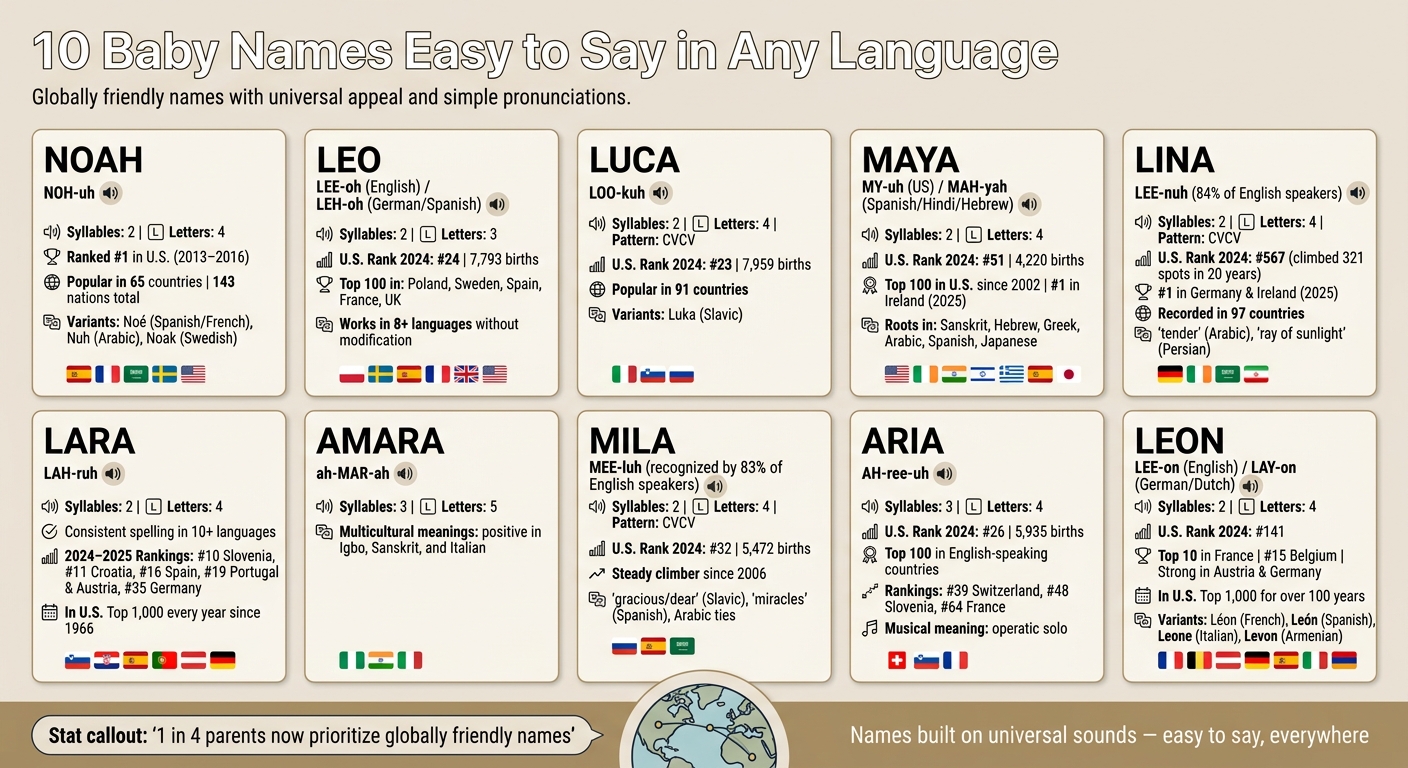
- Noah: Recognized in over 65 countries with variants like Noé (French/Spanish) and Nuh (Arabic).
- Leo: A three-letter name that remains consistent across dozens of languages.
- Luca: A four-letter name with a smooth structure and global pronunciation.
- Maya: Found in Sanskrit, Hebrew, and Spanish, with consistent pronunciation.
- Lina: Popular in Arabic, Germanic, and Slavic regions with meanings like "tender" and "ray of sunlight."
- Lara: Simple and widely used in Germanic, Romance, and Slavic languages.
- Amara: A multicultural name with positive meanings in Igbo, Sanskrit, and Italian.
- Mila: Common in Slavic, Spanish, and Arabic traditions, meaning "gracious" or "miracle."
- Aria: A vowel-heavy name with ties to music and global appeal.
- Leon: Derived from the word "lion", used widely across Europe and beyond.
These names are practical for multilingual families, easy to pronounce worldwide, and avoid common pitfalls like mispronunciation or negative connotations. Whether you're looking for a name with historical roots or modern simplicity, these options offer a great balance.
10 Baby Names Easy to Say in Any Language: Global Stats & Pronunciation Guide
1. Noah
Noah is a simple, two-syllable name (pronounced NOH-uh) with sounds that feel natural in many languages. The open "OH" and soft "AH" make it easy to pronounce, and the silent "h" at the end gives it a soft, pleasing finish. This simplicity contributes to its widespread recognition and popularity. If you're feeling overwhelmed, follow our guide to naming your baby without stress to keep the process enjoyable.
It’s no surprise that Noah ranks as one of the top boy names in 65 different countries, with around 850,882 people bearing the name across 143 nations. In the United States, it dominated as the #1 boy name from 2013 to 2016, with 19,171 babies named Noah in 2016 alone.
What makes Noah even more versatile is how it seamlessly adapts to different languages while keeping its essence intact:
| Language | Local Variant |
|---|---|
| Spanish/French | Noé |
| Italian | Noè |
| Finnish | Nooa |
| Arabic/Turkish | Nuh |
| Swedish | Noak |
Next, let’s dive into another globally loved name - Leo.
sbb-itb-f13f980
2. Leo
Leo is a short, sleek name: three letters, two syllables, one consonant, and two vowels. Its simplicity makes it easy to use and recognize across different languages, contributing to its global charm.
One of Leo's standout features is its consistent spelling, no matter the language. As Abby Sandel points out:
"Short and straightforward Leo is unchanged in dozens of languages, from Finnish to Croatian to Dutch and beyond."
However, pronunciation can vary slightly depending on where you are. English speakers typically say LEE-oh, while in German, Finnish, and Spanish, it’s often pronounced LEH-oh. Despite these differences, both versions are widely understood and accepted.
In 2024, Leo ranked #24 for U.S. boys, with 7,793 babies given the name. It also holds a spot in the Top 100 in countries like Poland, Sweden, Spain, France, and the United Kingdom. Interestingly, since 2010, more American parents have chosen the simple "Leo" over longer versions like Leonardo or Leonidas, showing the appeal of its standalone elegance.
Jack Lin of NamesPop highlights another reason for Leo's popularity:
"Leo works in English, Spanish, Italian, German, French, Portuguese, Mandarin, and Japanese phonetics without modification. That's a smaller list of accommodations than even Lucas requires."
This ease of use across languages makes Leo especially appealing for multilingual families. You can also use a baby name heritage finder to explore other names with deep cultural roots.
3. Luca
Luca is a short, two-syllable name with just four letters. Its structure follows the CVCV pattern - Consonant, Vowel, Consonant, Vowel - which is one of the easiest and most natural sequences for people to pronounce across nearly all major language groups. Each letter in Luca aligns with sounds common in Romance, Germanic, and Slavic languages, making it universally accessible. Plus, the name’s simple spelling eliminates any guesswork - there are no silent letters, tricky clusters like "th" or "str", or unexpected pronunciations. As Cuqui Baby Names explains:
"Luca (LOO-kuh) is an easy name to pronounce with a soft sonority."
What sets Luca apart is its consistency in pronunciation across different languages, with only slight vowel shifts. This kind of uniformity is rare among names:
| Language | Pronunciation |
|---|---|
| Italian | [ˈluːka] |
| Romanian | [ˈluka] |
| English | /ˈluː.kə/ |
| German | /ˈluːka/ |
Currently, Luca is a favorite in 91 countries, and in 2024, it ranked #23 in the U.S., with about 7,959 babies receiving the name that year. Abby Sandel, Founder of Appellation Mountain, highlights the universal charm of the name, noting that songwriter Suzanne Vega chose the spelling "Luka" for her fictional child specifically because of its global resonance. Whether spelled as Luca or Luka - the Italian and Slavic versions, respectively - the pronunciation remains nearly identical, making it a truly international choice. If you and your partner are struggling to agree on a global favorite, you can swipe baby names together to find a match. Up next, we’ll explore another name known for its worldwide appeal.
4. Maya
Maya is a simple, elegant name with just four letters and two syllables. Its basic sounds - starting with "M" and ending with the open "ah" - make it easy to pronounce in various languages. As the NameBlooms Editorial Team describes it:
"Maya best fits parents looking for an international fluid signal: the short vowel-forward shape and cross-cultural signal make the name easier to carry across US, European, and multilingual family contexts."
The name Maya has roots in many cultures, appearing in Sanskrit, Hebrew, Greek, Arabic, Spanish, and Japanese. This widespread presence makes it instantly recognizable and relatable across the globe. Abby Sandel, Founder of Appellation Mountain, highlights its universal appeal:
"Maya fits in nearly anywhere on the planet, for a child or an adult, across barriers of race and religion."
Its pronunciation is consistent and straightforward, regardless of the region:
| Language/Region | Common Pronunciation |
|---|---|
| United States | MY-uh |
| United Kingdom | MAY-uh |
| Spanish | MAH-yah |
| Sanskrit/Hindi | MAH-yah |
| Hebrew | MAH-yah |
Maya has been a popular choice in the U.S., consistently ranking among the top 100 girl names since 2002. In 2024, it held the #51 spot with around 4,220 births, and even reached #1 in Ireland by 2025. Its enduring popularity reflects its universal charm. As Mom Loves Best puts it:
"Maya hits the 'sweet spot' of baby naming: it is easy to spell, easy to pronounce in almost any language, ends in a soft vowel... and has positive meanings across different cultures."
If you're struggling to find similar options, you can use AI to name your baby smarter by filtering for cross-cultural appeal. Up next, explore another name that seamlessly connects across cultures.
5. Lina
Lina follows a straightforward CVCV structure, with soft "L" and "N" sounds that make it easy to pronounce in nearly any language.
The name's -a ending gives it a smooth, adaptable quality that fits seamlessly into Arabic, Latin, Germanic, Slavic, and Scandinavian languages. This makes Lina feel neutral yet universally appealing.
"Lina's cross-cultural versatility is one of its greatest strengths - it works in Arabic, Swedish, Italian, Spanish, and English-speaking households with equal grace." - NamesPop Editorial Team
Lina's global popularity is backed by data and trend insights. It's recorded in 97 countries, claimed the #1 spot for girls in Germany and Ireland in 2025, and has been a favorite in France since 2019. In the U.S., it climbed 321 spots over two decades, reaching #567 in 2024. Among English speakers, 84% pronounce it as "LEE-nuh".
The name also carries rich meanings across cultures. In Arabic, Lina signifies "tender" or "young palm tree." In Persian, it translates to "ray of sunlight", while in Chinese, it conveys a melodious tone. These layers of meaning make Lina an excellent choice for families navigating multiple languages and traditions. Up next, we’ll look at another name that balances traditional and modern baby name qualities.
6. Lara
Let’s take a closer look at Lara, a name that resonates across languages and cultures.
Lara is delightfully simple to pronounce. Spoken as LAH-ruh, this two-syllable name flows naturally thanks to its combination of a soft "L", an open "A", and a crisp "R." These sounds are familiar across many language groups, including Germanic, Romance, Slavic, and Semitic families, making it easy to say no matter where you are. Even better, Lara’s spelling remains consistent in English, German, French, Italian, Spanish, Portuguese, Dutch, Hungarian, Slovene, and Croatian. This consistency makes it a fantastic choice for families with multicultural ties.
"Lara is a culture-spanning choice. She's as simple as Lily or Emma." - Abby Sandel, Founder, Appellation Mountain
Lara’s popularity reinforces its universal appeal, reflecting current baby naming trends. In 2024 and 2025, it ranked among the top names in several countries: #10 in Slovenia, #11 in Croatia, #16 in Spain, #19 in both Portugal and Austria, and #35 in Germany. In the U.S., Lara has held a spot in the Top 1,000 names every year since 1966. For such a short and straightforward name, its long-standing global success is truly impressive.
7. Amara
This section dives into the rich cultural and historical tapestry of the Beira Alta region in Portugal. It highlights Tejo, a traditional Portuguese sport, offering a glimpse into local customs. It also explores Faia, a quaint village, and Linhares, a historical gem known for its charm and significance.
The Egas Moniz Bridge is mentioned as a noteworthy landmark, connecting visitors to the area's storied past. Additionally, the Côa Valley and its archaeological park are spotlighted, showcasing ancient rock art and a connection to Portugal's deep-rooted history. The content paints a vivid picture of the region, making it an enticing destination for travelers interested in history, culture, and tradition.
8. Mila
Mila is a short, two-syllable name with a simple CVCV structure, making it easy to pronounce across the globe. Thanks to its familiar sounds - "M", "L", "ee", and "ah" - it rolls off the tongue for speakers of Spanish, Arabic, Russian, French, and many other languages without any need for adjustment.
Much like Lara, Mila thrives on its simplicity and universal accessibility. The most common pronunciation, "MEE-luh", is confidently recognized by 83% of English speakers. This consistency reduces the likelihood of mispronunciations or misspellings, no matter where you are.
Mila's widespread appeal is rooted in its multicultural origins. In Slavic languages, it means "gracious" or "dear." In Spanish, it’s often a short form of Milagros, meaning "miracles." It also has ties to Arabic traditions, giving it a sense of familiarity across different regions and cultures. As Abby Sandel, Founder of Appellation Mountain, describes it:
"Mila blends the traditional and the modern, a straightforward name that's less expected than Emma or Ella, but every bit as wearable."
The numbers show its enduring charm. In 2024, Mila ranked #32 among girls' names in the United States, with approximately 5,472 babies given the name that year. Unlike names that rise and fall quickly, Mila has been a Steady Climber since it first surpassed 100 annual births in 2006. This steady growth suggests it’s here to stay, rather than just riding a fleeting trend.
9. Aria
Aria is a name that feels effortlessly global. Its simple, four-letter structure mirrors its sound - AH-ree-uh - making it easy for most people to pronounce correctly on their first try.
What makes Aria so adaptable is its vowel-heavy composition. It starts and ends with the open "ah" sound, a feature common in many languages. The key phonetic elements - "ah", "ree", and the soft ending - are naturally present in languages like Spanish, Hindi, Bengali, Persian, and Vietnamese. This gives the name a consistency in pronunciation across cultures.
Aria also carries a built-in musical association. As a term for an operatic solo in classical music, it resonates with speakers of many languages, even those who might not recognize it as a personal name. Abby Sandel from Appellation Mountain captures its charm perfectly:
"A melodic sound for a musical name, the baby name Aria blends our love of word names, fictional heroines, and flowing, liquid style."
In terms of popularity, Aria ranked #26 among girls' names in the United States in 2024, with around 5,935 babies receiving the name that year. Its appeal isn’t limited to the U.S. - it’s a Top 100 choice in other English-speaking countries and holds notable positions in Switzerland (#39), Slovenia (#48), and France (#64). Similar to Mila, Aria has seen steady growth since the early 2000s rather than a sudden surge tied to a particular trend.
Now, let’s move on to the final name in this series, continuing the theme of global simplicity.
10. Leon
Leon wraps up the list with its short, striking sound and timeless appeal. This two-syllable, four-letter name is built from universally familiar letters - L, E, O, and N - making it easy to recognize and pronounce.
Its origins are steeped in history, tracing back to the Ancient Greek word leōn and the Latin leo, both meaning "lion". Thanks to this strong linguistic foundation, Leon spread early across Europe, appearing in various forms like Léon in French, León in Spanish, Leone in Italian, and Levon in Armenian.
Pronunciation shifts depending on the language. In English, it's commonly said as "LEE-on." German and Dutch speakers lean toward "LAY-on", while Spanish speakers emphasize the second syllable. Despite these differences, the name's simplicity and charm have made it increasingly popular.
"Leon is the perfect 'Goldilocks' choice for a baby born in 2026. It offers the beloved nickname 'Leo' but stands on its own as a complete name that ages well." - MomLovesBest
Leon has seen a resurgence in recent years. After a dip in 2005, it now ranks #141 for boys in the U.S. as of 2024. It’s also a top choice internationally, ranking among the top 10 in France and holding strong in Belgium (#15), Austria, and Germany. Impressively, Leon has stayed in the U.S. top 1,000 for over a century, a testament to its cross-cultural appeal and enduring relevance. It’s a name that truly bridges traditions and modern trends. If you love this aesthetic, you can explore similar options with a baby name style planner.
Conclusion
This list has spotlighted names that cross borders with ease, thanks to their universal sounds and simplicity. Picking a name that resonates globally isn’t just a preference - it’s a practical choice. Whether your family is multilingual, spread across countries, or simply looking to avoid constant mispronunciations, a name that’s easy to say and recognize worldwide can make life a bit easier. As linguist Clare Green, a contributor to Nameberry, aptly stated: "It can be embarrassing and upsetting when grandma can't pronounce her granddaughter's name."
The names Noah, Leo, Luca, Maya, Lina, Lara, Amara, Mila, Aria, and Leon all share a key trait: they’re built on straightforward syllables, familiar consonants, and smooth vowel sounds that feel natural in many languages. A study even found that 1 in 4 parents now prioritize choosing names that "work globally" across cultures and languages, a shift reflected in recent baby name analytics.
Beyond fostering family unity, globally friendly names can simplify official processes, avoid awkward translations, and even provide a subtle edge in professional settings. These benefits highlight why selecting an international name is a thoughtful and forward-thinking choice.
"Choosing an international name is a beautiful way to give your child a head start in a global world, providing them with a name that is both unique and universally loved." - MyNameList
FAQs
How can I tell if a name is easy in many languages?
To pick a name that's easy to pronounce across different languages, consider options rooted in Biblical or classical traditions, as these tend to be familiar worldwide. Focus on names with straightforward spellings and clear pronunciation, steering clear of nicknames or abbreviations. Names with open vowel sounds are often easier for people from various linguistic backgrounds to say. Tools like NameHatch can help you discover globally-friendly names that align with your preferences.
Do these names have negative meanings in any culture?
The names highlighted - like Kiara, Mahia, Mahi, Kaleah, Krishna, Falak, and Hatch - are often linked to uplifting or meaningful themes, such as nature, spirituality, or happiness. While some may carry alternate meanings or interpretations, they are commonly viewed as symbolic or culturally important. For tailored name ideas, NameHatch offers a tool to help you discover options that match your style and preferences.
Which of these names are best for bilingual families?
The best names for bilingual families are those that are simple to pronounce, feature clear vowel sounds, and maintain consistent spelling across languages. These names naturally fit into different linguistic and cultural contexts without needing translation or pronunciation guides. Examples of such names include Emma, Noah, Leo, Sofia, and Mia. If you're looking for personalized suggestions, tools like NameHatch allow you to swipe through options based on your preferences and even collaborate with your partner to build a shared shortlist.